Agenda item
Notice of Motion by Councillor Moore under Standing Order No. 6
Motion: Local Housing Allowance
Local Housing Allowance (LHA) rates are used to calculate Housing Benefit or universal Credit for tenants renting from private landlords.
Exeter, like other areas, is experiencing a housing crisis and suffered unsustainable rent increases across the private rented sector and loss of homes to Air B&B and HMOs. This situation is recognised in the Devon Housing Commission Report 2024. Average rents in Exeter are, in March 2025, as high as those in the South East of England.
The LHA rates are based on the 30th percentile figures from twelve months' letting information in the Broad Market Rental Area but are insufficient to cover even the cheapest rooms or homes in Exeter. LH Rates have been subject to a freeze since 2020 and the Labour Government has confirmed the rates will be frozen at current levels until 2026.
When a local authority places a household in temporary accommodation (TA) it can claim back the incurred costs associated with the provision of the TA from the Department for Work and Pensions (DWP). Apart from households placed in council-owned stock outside the Housing Revenue Account (HRA), for which a local authority can reclaim up to the current Local Housing Allowance (LHA) rates, the local authority can generally reclaim up to 90 per cent of the January 2011 LHA rates, which were set based on the rental costs at that time. These rates are now outdated and do not accurately reflect current market conditions. The gap in financing between what local authorities initially pay and what is eventually reimbursed by the national government is known as the Temporary Accommodation Subsidy Gap. The current reimbursement system, which largely relies on these outdated 2011 rates, exacerbates this Subsidy Gap.
As such Council:
- Acknowledges the endemic housing crisis affecting our communities across Exeter and the current inadequacy of Local Housing Allowance, frozen since April 2020;
- Notes that Local Housing Allowance has not kept pace with rising rents;
- Expresses concern that Temporary Accommodation Subsidy Gap places additional strain on local authority budgets.
- Implores Government to commit to immediate interventions to alleviate the housing and homelessness emergency in the short term; and
- Notes the anomalies in the LHA guidance in relation to the Shared Accommodation Rate, for example:
- The rate applies to single people without children aged 25-34 - which limits opportunities and lifestyle choices;
- Multi Agency Public Protection Arrangements (MAPPA) limitations apply from age 25;
- Pregnant women under the age of 35 pregnant are expected to be accommodated in an HMO and can only apply for a higher rate for a one bed property after the birth of the child.
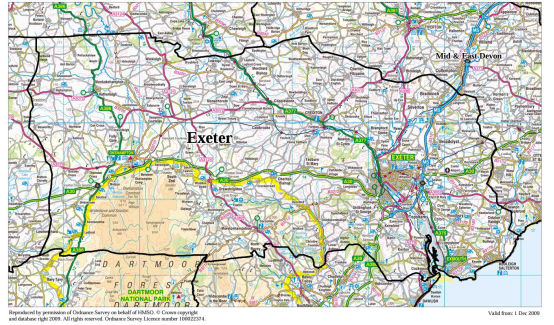
- Notes that the Exeter Broad Rental Market Area for Exeter covers a very large rural area, so drags down the LHA making rental properties in the urban area unaffordable.
Government to
1. Unfreeze, relink and consistently uprate the Local Housing Allowance levels so they cover rents for the 30% cheapest private rented sector properties4 in every local authority area; and address the Temporary Accommodation Subsidy Gap.
2. Redefining the Broad Rental Market Areas covered by Local Housing Allowance at a level that better reflects local rental markets'.
3. Review the Shared Accommodation Rate anomalies listed above to lower the MAPPA age and enable pregnant women to apply for a higher rate before the birth of their child(ren).
Map of Broad Rental Market Area for Exeter
Minutes:
Councillor Moore moved and was seconded by Councillor Banyard, a Notice of Motion in the following terms:
“Local Housing Allowance (LHA) rates are used to calculate Housing Benefit or universal Credit for tenants renting from private landlords.
Exeter, like other areas, is experiencing a housing crisis and suffered unsustainable rent increases across the private rented sector and loss of homes to Air B&B and HMOs. This situation is recognised in the Devon Housing Commission Report 2024. Average rents in Exeter are, in March 2025, as high as those in the South East of England.
The LHA rates are based on the 30th percentile figures from twelve months' letting information in the Broad Market Rental Area but are insufficient to cover even the cheapest rooms or homes in Exeter. LH Rates have been subject to a freeze since 2020 and the Labour Government has confirmed the rates will be frozen at current levels until 2026.
When a local authority places a household in temporary accommodation (TA) it can claim back the incurred costs associated with the provision of the TA from the Department for Work and Pensions (DWP). Apart from households placed in council-owned stock outside the Housing Revenue Account (HRA), for which a local authority can reclaim up to the current Local Housing Allowance (LHA) rates, the local authority can generally reclaim up to 90 per cent of the January 2011 LHA rates, which were set based on the rental costs at that time. These rates are now outdated and do not accurately reflect current market conditions. The gap in financing between what local authorities initially pay and what is eventually reimbursed by the national government is known as the Temporary Accommodation Subsidy Gap. The current reimbursement system, which largely relies on these outdated 2011 rates, exacerbates this Subsidy Gap.
As such Council:
1) acknowledges the endemic housing crisis affecting our communities across Exeter and the current inadequacy of Local Housing Allowance, frozen since April 2020;
2) notes that Local Housing Allowance has not kept pace with rising rents;
3) expresses concern that Temporary Accommodation Subsidy Gap places additional strain on local authority budgets.
4) implores Government to commit to immediate interventions to alleviate the housing and homelessness emergency in the short term; and
5) notes the anomalies in the LHA guidance in relation to the Shared Accommodation Rate, for example:
6) the rate applies to single people without children aged 25-34 - which limits opportunities and lifestyle choices;
7) Multi Agency Public Protection Arrangements (MAPPA) limitations apply from age 25;
8) pregnant women under the age of 35 pregnant are expected to be accommodated in an HMO and can only apply for a higher rate for a one bed property after the birth of the child.
9) notes that the Exeter Broad Rental Market Area for Exeter covers a very large rural area, so drags down the LHA making rental properties in the urban area unaffordable.
Government to
1) unfreeze, relink and consistently uprate the Local Housing Allowance levels so they cover rents for the 30% cheapest private rented sector properties4 in every local authority area; and address the Temporary Accommodation Subsidy Gap;
2) redefining the Broad Rental Market Areas covered by Local Housing Allowance at a level that better reflects local rental markets; and
3) review the Shared Accommodation Rate anomalies listed above to lower the MAPPA age and enable pregnant women to apply for a higher rate before the birth of their child(ren).”
In presenting the Motion, Councillor Moore made the following points:
- people were losing family networks as they could not afford to live in the City;
- LHA provided allowance through Universal Credit, in February 2025, 4580 households on UC were working, and 7169 were not in work. Almost 7% of households in Exeter were in receipt of housing benefits; and
- in 2022/23 Customer Focus Scrutiny Committee looked at homelessness, and was referred to the Devon Housing Commission, this motion was a continuation of that work.
Councillor Banyard, as seconder, spoke in support of the motion:
- LHA rates were set according to rental market area and extended past Hatherleigh. It would take 1 hour and 38 minutes to get a bus into Exeter from Hatherleigh; and
- rates were not set by looking at what was affordable in Exeter but looking at what a small flat might cost in a rural area such as Hatherleigh.
During debate, members spoke in support of the motion making the following comments:
- regarding temporary accommodation there were quality concerns, and costs had continued to rise which meant there was an overspend of the budget. The Council would now be switching to long term leases, and aim to reduce unit costs, and improve quality;
- long term leases would enable break even at 95% occupancy levels;
- there was a housing crisis in Exeter, and it was difficult to find affordable accommodation;
- the LHA required a review of boundaries and levels, and hopefully the Council would investigate this irrespective of this motion;
- more housing needed to be built, and for those to be affordable; and
- housing was seen as an asset rather than a place to live.
In summing up, Councillor Moore made the following points:
· an update on temporary accommodation was welcomed;
· concerns over rent inflation were understood;
· LHA expected to be sufficient to fund the cheapest accommodation hence the Hatherleigh drag issue; and
· she welcomed the comments on working together through the LGA.
Following a unanimous vote the Motion was CARRIED.